Exploratory case study — non-normative
This page is not part of the normative UJG specification. It documents a controlled generative-software experiment and is updated as evaluation evidence is completed.
| Implementation models | GPT-5.5 Codex, Claude Sonnet 5 |
| Experiment repository | openuji/ujg-generative-se-case-study |
| UJG version | UJG 1.0 Release Candidate 2 |
| Author | Seva Dolgopolov |
1. Research question
A User Journey Graph describes what a user should be able to do, separately from how any one piece of software builds it. AI code generation is a good way to test that separation: different models write very different code, yet all of them can be held to the same intended experience.
This case study asks two related questions:
RQ-1: Can one UJG hold several AI models to the same journey without dictating how each one builds it?
RQ-2: Does gating the handover between phases lead to a better build that stays closer to the UJG?
So the study compares two things at once: the models, and the guidance protocols used to steer them. The same inputs are built twice — once through a loosely guided process, once through an explicitly staged one.
The aim is not identical code or identical screens. It is to see whether independently generated builds keep the same meaning, and whether their quality changes when generation is broken into stages that can be inspected and verified one at a time.
2. What is held constant
Every run started from the same four things: a UJG document with its schemas, an implementation manifest, reference screenshots for the visual style, and a fixed technology profile. No run was given a reference application to copy from.
2.1. UJG
Workshop registration UJG · schemas
UJG Document Graph Nodes
The UJG is the single source of meaning and structure for the experiment.
2.2. Implementation manifest
domain_engine:
  target: apps/domain

interfaces:
  - touchpoint_ref: urn:ujg:touchpoint:workshop-app
    target: apps/ui
    kind: browser

  - touchpoint_ref: urn:ujg:touchpoint:email
kind: emaildomain_engine:
target: apps/domain
interfaces:
- touchpoint_ref: urn:ujg:touchpoint:workshop-app
target: apps/ui
kind: browser
- touchpoint_ref: urn:ujg:touchpoint:email
kind: emailThe manifest fixes what gets built and where, identically in every run: a domain engine, a browser app, and email.
2.3. Reference screenshots
10 screenshots — the only evidence the models were given for how the product should look.


2.4. What varies
The only thing that changes is the guidance protocol that walks it through the work.
The guidance itself splits in half. The work each skill performs — build the structure, derive the tokens, apply the styling, build the application — is the same in every run. What changes is how those skills are coordinated, and what has to pass before the next phase opens. That difference is the subject of Two guidance protocols.
3. The 3 + 1 realization process
Building is split on purpose into three design-system phases, followed by the application itself.
flowchart TD

    U["UJG, Manifest, Screenshots"] --> S["1 · Structure"]

    S --> T["2 · Tokens"]

    T --> V["3 · Styling"]

    V --> A["+1 · Application"]

    S --> SO["Components · Templates · Slots · Stories"]

    T --> TO["DTCG tokens · Themes · provenance"]

    V --> VO["Styled + responsive Storybook artifacts"]

    A --> AO["Browser · domain runtime · persistence · email"]
3.1. Structure
Structure builds the skeleton of the design system before any visual decision exists: Components, Templates, Slots, SlotBindings, SurfaceRealizations, data-bound props, and the Storybook stories that make them inspectable.
The question here is whether that skeleton keeps the UJG composition — or collapses modeled pieces into ad-hoc screens and hides application behavior inside components.
3.2. Tokens
Tokens turn the screenshots into a reusable visual foundation. Raw values such as color, spacing, and type stay separate from the semantic tokens that name roles like action foreground; Themes differ by data only; and every token records whether its value was visible in a screenshot or inferred.
This phase also writes the generated Theme and TokenSource back into the run's own copy of the UJG, without touching the journey it was given.
3.3. Styling
Styling applies the token system to the components and templates that already exist. It is judged on two things: how close the result comes to the references, and whether it leaves the earlier structure alone.
So the telling comparison is not a final screenshot but the same modeled artifact before and after styling, seen on mobile and desktop wherever responsive behavior exists.
3.4. Application
The last phase builds what the manifest selected: the browser application, domain runtime, HTTP/OpenAPI boundary, SQLite persistence, identity adapter, and email delivery adapter.
The question now shifts from how it looks to how it behaves: do entries, commands, guarded branches, effects, invariants, continuations, data contracts, and touchpoint boundaries survive implementation?
4. Two guidance protocols
Each model runs the job twice. Between its two runs the inputs and the work stay fixed, and only the coordination and the gates change.
| – | Implicit-gatedGuidance protocol. A single orchestration skill walks the model through structure → tokens → styling in sequence. The phase boundaries live inside that guidance rather than being enforced from outside. guidance | Explicit-gatedGuidance protocol. Every phase is a separate, fresh model invocation that is explicitly opened and closed, and static validation plus executable verification must pass before the next phase may start. guidance |
|---|---|---|
| Design-system generation | One orchestration skill guides structure → tokens → styling in sequence. | Structure, tokens, and styling are separate model invocations. |
| Application generation | Separate application realization. | Separate application realization. |
| Phase boundary | Mostly encoded inside orchestration guidance. | Every phase is explicitly opened and closed. |
| Verification | Retained legacy validation/evaluation evidence. | Static validation and executable verification must pass before the next phase starts. |
| Main question | Can a model hold the phase boundaries from guidance alone? | Does gating the handover produce a better build that stays closer to the UJG? |
flowchart TB

    subgraph E["Explicit-gated"]

      direction TB

      EC["DS coordinator skill<br/>control-only"] --> EB1["begin structure phase"]

      EB1 --> ES["Structure skill<br/>fresh invocation"]

      ES --> EG1["validate + verify<br/>close structure"]

      EG1 --> EB2["begin tokens phase"]

      EB2 --> ET["Token skill<br/>fresh invocation"]

      ET --> EG2["validate + verify<br/>close tokens"]

      EG2 --> EB3["begin styling phase"]

      EB3 --> EST["Styling skill<br/>fresh invocation"]

      EST --> EG3["validate + verify<br/>close styling"]

      EG3 --> EB4["begin application phase"]

      EB4 --> EA["Application skill<br/>fresh invocation"]

      EA --> EG4["validate + verify<br/>close application"]

      EG4 --> EE["post-generation evaluations<br/>structure + tokens + styling + application"]

    end

    subgraph I["Implicit-gated"]

      direction TB

      IC["DS coordinator skill<br/>executes DS phases"] --> IS["Structure skill"]

      IS --> IG1["validate + verify"]

      IG1 --> IE1["evaluate structure"]

      IE1 --> IT["Token skill"]

      IT --> IG2["validate + verify"]

      IG2 --> IE2["evaluate tokens"]

      IE2 --> IST["Styling skill"]

      IST --> IG3["validate + verify"]

      IG3 --> IE3["evaluate styling"]

      IE3 --> IA["Application skill"]

      IA --> IG4["validate + verify"]

      IG4 --> IE4["evaluate application<br/>complete validation"]

    end

    top(( )):::anchor

    top ~~~ EC

    top ~~~ IC

    classDef anchor width:0px,height:0px,fill:none,stroke:none
Both protocols use the same technology profile. The difference is not “Claude used one stack and Codex another” — it is how explicitly the phases and their gates are handed to the model.
5. Experiment matrix
Four runs are retained in the repository.
| Implementation model | Implicit-gatedGuidance protocol. A single orchestration skill walks the model through structure → tokens → styling in sequence. The phase boundaries live inside that guidance rather than being enforced from outside. | Explicit-gatedGuidance protocol. Every phase is a separate, fresh model invocation that is explicitly opened and closed, and static validation plus executable verification must pass before the next phase may start. |
|---|---|---|
| GPT-5.5 Codex | ✓ | ✓ |
| Claude Sonnet 5 | ✓ | ✓ |
6. Evaluation design
Each run is scored separately for each of the four phases. Every phase has six quality dimensions scored from 0 to 5; their average is the phase score, published on a 0–100 scale (that average × 20).
Complexity indicators — file count, infrastructure LOC, dependency count, abstraction burden — are reported separately. They do not raise or lower the quality score.
| Phase | Quality dimensions |
|---|---|
| StructurePublished phase score · 0–100. How well the generated design-system structure matches the UJG model: artifact coverage, composition, data contracts, identity, modularity, and Storybook inspectability. The score is the mean of six 0–5 quality scores, averaged across both evaluators. Higher is better. | Artifact coverageQuality score · 0–5. How completely the implementation contains the UJG Components and Templates it is expected to realize. Higher is better. · Composition fidelityQuality score · 0–5. How closely generated Templates, Slots, and their composition follow the UJG design-system model. Higher is better. · Data-contract fidelityQuality score · 0–5. How accurately generated artifact inputs and outputs follow the UJG-referenced data contracts. Higher is better. · Identity containmentQuality score · 0–5. Whether UJG identities stay clear in the implementation instead of being duplicated or replaced by competing semantic identities. Higher is better. · Implementation modularityQuality score · 0–5. How well the generated code reuses implementation pieces instead of repeating the same logic or structure. Higher is better. · Storybook inspectabilityQuality score · 0–5. How easily generated Components, Templates, states, and interactions can be inspected in Storybook. Higher is better. |
| TokensPublished phase score · 0–100. How well the generated DTCG token and Theme realization works: token structure, source-of-truth discipline, portability, traceability, visual fidelity, and inspectability. The score is the mean of six 0–5 quality scores, averaged across both evaluators. Higher is better. | DTCG token-model qualityQuality score · 0–5. How clear, reusable, and well-structured the generated foundation and semantic DTCG token system is. Higher is better. · Source-of-truth integrityQuality score · 0–5. How consistently the implementation uses the intended authoritative source—such as DTCG tokens, UJG, or schemas—instead of maintaining competing copies. Higher is better. · Theme portabilityQuality score · 0–5. How easily Themes can change through token data rather than component-specific theme logic. Higher is better. · TraceabilityQuality score · 0–5. How well generated token decisions can be traced to supplied screenshot evidence or recorded inference. Higher is better. · Visual-foundation fidelityQuality score · 0–5. How well the generated token foundation reflects the supplied visual references. Higher is better. · InspectabilityQuality score · 0–5. How easily the generated result for the phase can be inspected through Storybook, documentation, or other retained evidence. Higher is better. |
| StylingPublished phase score · 0–100. How well styling applies the generated token system without changing the established structure, while preserving visual and responsive quality. The score is the mean of six 0–5 quality scores, averaged across both evaluators. Higher is better. | Visual fidelityQuality score · 0–5. How closely the generated styling reflects the supplied reference screenshots. Higher is better. · DTCG token/Theme adherenceQuality score · 0–5. How consistently styling uses the generated DTCG tokens and Themes instead of hardcoded or parallel visual values. Higher is better. · Structural-scope preservationQuality score · 0–5. Whether Styling preserves the Components, Templates, composition, and behavior established during Structure. Higher is better. · Responsive qualityQuality score · 0–5. How well the generated UI adapts across relevant viewport sizes. Higher is better. · Styling modularityQuality score · 0–5. How reusable and well-separated the styling implementation is, without avoidable duplication. Higher is better. · InspectabilityQuality score · 0–5. How easily the generated result for the phase can be inspected through Storybook, documentation, or other retained evidence. Higher is better. |
| ApplicationPublished phase score · 0–100. How well the generated application realizes the manifest-selected interfaces and preserves UJG behavior, domain rules, design-system integration, source-of-truth boundaries, and verification. The score is the mean of six 0–5 quality scores, averaged across both evaluators. Higher is better. | Manifest realization coverageQuality score · 0–5. How completely the application implements the targets and interfaces selected by the implementation manifest. Higher is better.
· UJG behavioral fidelityQuality score · 0–5. How closely runtime behavior follows the UJG, including entries, commands, conditions, branches, effects, outcomes, and continuations. Higher is better.
· Domain integrityQuality score · 0–5. How consistently the generated runtime enforces the domain rules and invariants relevant to the journey. Higher is better.
· Design-system integrationQuality score · 0–5. How correctly application interfaces use the generated design system instead of rebuilding presentation or interaction behavior separately. Higher is better.
· Source-of-truth integrityQuality score · 0–5. How consistently the implementation uses the intended authoritative source—such as DTCG tokens, UJG, or schemas—instead of maintaining competing copies. Higher is better.
· Verification coverageEvaluator diagnostic or quality score, depending on context. As a percentage, it is verified branches / modeled branches. As a 0–5 quality score, it judges the breadth and usefulness of maintained executable verification. Higher is better.
|
6.1. Two evaluators, one published phase score
Every retained implementation is evaluated by both models — each one scores its own work and the other's.
For each run and phase:
published phase score = mean(Claude evaluator score, GPT-5.5 Codex evaluator score)
Each evaluator's own numbers are kept so disagreement stays visible; the mean is used only for the comparable phase scores.
Diagnostic counts are never averaged. Even seemingly factual measurements depend on interpretation — which files count as infrastructure, which branches count as modeled, what counts as a prohibited projection.
6.2. Deterministic and diagnostic evidence
Results combine three kinds of evidence.
| Evidence | Source | Examples |
|---|---|---|
| Deterministic repository metrics | Counted directly from generated artifacts | Components, Templates, Slots, SurfaceRealizations, implementation primitives, DTCG token counts, Themes |
| Evaluator diagnostics | Phase evaluation JSON | composition violations, raw-value leaks, responsive coverage, verified branches, parallel semantic projections |
| Evaluator quality judgments | Six scored dimensions per phase | source-of-truth integrity, token/theme adherence, UJG behavioral fidelity |
Anything countable is counted from the generated code; evaluator diagnostics cover what needs interpretation, and evaluator scores cover judgment. This is why every results table below keeps repository counts and evaluator findings apart — the design-system inventory, the helper count, and the token inventory are counted, never inferred from a score.
6.3. Evaluator disagreement
Where the two evaluators disagree is itself evidence. It comes in two kinds:
measurement disagreement — they find or count different evidence;
judgment disagreement — they look at the same evidence and score it differently.
Large disagreements are shown rather than hidden behind the mean.
7. RQ1 — Cross-model convergence
Can one UJG hold several AI models to the same journey without dictating how each one builds it?
All four runs share the same UJG and the same technology profile. That makes it possible to ask whether independently generated builds meet at the modeled boundaries while still choosing their own code architecture and helpers.
7.1. Structural convergence
The UJG design system defines one shared vocabulary for every run:
Modeled design-system structure
Shared UJG input for all four runs
Artifacts
All four runs build the complete Component and Template inventory.
7.1.1. Repository-derived structure metrics
| Run | ComponentsRepository metric. Number of UJG Component identities implemented out of the number expected.
12 / 12 means every modeled Component has an implementation artifact.
| TemplatesRepository metric. Number of UJG Template identities implemented out of the number expected.
9 / 9 means every modeled Template has an implementation artifact.
| Implementation primitivesRepository metric. Additional reusable UI helpers created by the implementation, such as a small Field, Card, or StatusIcon.
They are implementation choices, not UJG Components or Templates. More or fewer is not automatically better.
|
|---|---|---|---|
| Claude Sonnet 5 · explicit | 12 / 12 | 9 / 9 | 3 |
| Claude Sonnet 5 · implicit | 12 / 12 | 9 / 9 | 4 |
| GPT-5.5 Codex · explicit | 12 / 12 | 9 / 9 | 0 |
| GPT-5.5 Codex · implicit | 12 / 12 | 9 / 9 | 2 |
Component, Template, Slot, and SurfaceRealization come from the UJG. Implementation primitives are extra helpers a model invented for itself — its own choice, not something the UJG asked for.
Every run implements all 12 Components and all 9 Templates. They differ only in how they cut things up internally, adding between zero and four helpers of their own.
7.1.2. Structure diagnostics — GPT-5.5 Codex evaluator
| Run | Missing storiesEvaluator diagnostic. Number of generated Components or Templates that should be inspectable in Storybook but have no Storybook story. Lower is better; 0 means none are missing.
| Composition violationsEvaluator diagnostic. Number of places where generated Component/Template/Slot composition does not match the UJG design-system structure. Lower is better. | Data-contract violationsEvaluator diagnostic. Number of generated artifacts whose data shape does not match the UJG-referenced data contract. Lower is better. | Interaction-story coverageEvaluator diagnostic. Percentage of generated Components and Templates with modeled user actions that also have Storybook stories demonstrating those actions—for example open, edit, submit, confirm, accept, or decline.
100% means every expected interactive artifact has corresponding Storybook interaction evidence. Higher is better.
|
|---|---|---|---|---|
| Claude Sonnet 5 · explicit | 0 | 0 | 0 | 100% |
| Claude Sonnet 5 · implicit | 0 | 0 | 0 | 50% |
| GPT-5.5 Codex · explicit | 0 | 0 | 0 | 100% |
| GPT-5.5 Codex · implicit | 0 | 0 | 1 | 100% |
7.1.3. Structure diagnostics — Claude Sonnet 5 evaluator
| Run | Missing storiesEvaluator diagnostic. Number of generated Components or Templates that should be inspectable in Storybook but have no Storybook story. Lower is better; 0 means none are missing.
| Composition violationsEvaluator diagnostic. Number of places where generated Component/Template/Slot composition does not match the UJG design-system structure. Lower is better. | Data-contract violationsEvaluator diagnostic. Number of generated artifacts whose data shape does not match the UJG-referenced data contract. Lower is better. | Interaction-story coverageEvaluator diagnostic. Percentage of generated Components and Templates with modeled user actions that also have Storybook stories demonstrating those actions—for example open, edit, submit, confirm, accept, or decline.
100% means every expected interactive artifact has corresponding Storybook interaction evidence. Higher is better.
|
|---|---|---|---|---|
| Claude Sonnet 5 · explicit | 0 | 0 | 0 | 100% |
| Claude Sonnet 5 · implicit | 0 | 0 | 0 | 100% |
| GPT-5.5 Codex · explicit | 0 | 0 | 0 | 100% |
| GPT-5.5 Codex · implicit | 0 | 1 | 0 | 100% |
On the two explicit-gated runs the evaluators agree completely: full Storybook coverage of the evaluated interactions, and no missing stories, composition violations, or data-contract violations.
The implicit runs are where they part ways. On Claude implicit, the Codex evaluator sees 50% interaction-story coverage and the Claude evaluator 100%. On Codex implicit, the Claude evaluator finds one composition violation; the Codex evaluator finds one data-contract violation instead. Both readings are kept.
The structural picture is nevertheless one of strong convergence: all four builds realize the same 12 Components and 9 Templates, serving the same 54 SurfaceRealizations. They converge wherever the UJG models something — and the differing helper counts show it does not prescribe one source architecture.
7.2. DTCG token realization
The token phase turns the visual foundation into DTCG token files and Theme definitions.
7.2.1. Repository-derived token metrics
| Run | DTCG tokensRepository metric. Total number of design tokens in the generated DTCG token files. The count describes the implementation; a larger token inventory is not automatically better. | Foundation / semantic DTCG tokensRepository metric. Split between basic visual tokens—such as color, spacing, typography, radius, and shadow—and semantic tokens that name roles such as action foreground or error border. Different implementations may choose different splits. | ThemesRepository metric. Number of generated UJG Theme realizations backed by the run's token sources. | Direct provenanceRepository metric. Number of DTCG tokens whose value can be traced to something actually visible in the supplied screenshots — a color taken from a button, a spacing step read off a layout. | Inferred provenanceRepository metric. Number of DTCG tokens the model worked out rather than observed — completing a scale, deriving a dark-Theme counterpart, or covering a state the screenshots never showed. Inferred is not a defect. It records a decision the evidence did not force. | UnclassifiedRepository metric. Number of DTCG tokens carrying no provenance record at all, so there is no way to tell whether the value came from the screenshots or was invented.
Lower is better; 0 means every token is accounted for.
| DTCG token provenance coverageDerived repository metric. Percentage of generated DTCG tokens whose origin is classified as either directly supported by the screenshots or inferred during generation.
classified tokens / all DTCG tokens. Higher means more token decisions are traceable.
|
|---|---|---|---|---|---|---|---|
| Claude Sonnet 5 · explicit | 168 | 100 / 68 | 2 | 61 | 107 | 0 | 100.0% |
| Claude Sonnet 5 · implicit | 110 | 66 / 44 | 2 | 22 | 22 | 66 | 40.0% |
| GPT-5.5 Codex · explicit | 106 | 50 / 56 | 2 | 28 | 28 | 50 | 52.8% |
| GPT-5.5 Codex · implicit | 63 | 31 / 32 | 2 | 16 | 16 | 31 | 50.8% |
Token count describes a build; it does not grade it — a bigger catalogue is not a better one. The four runs differ widely in how many tokens they create and how they split foundation from semantic, yet all four produce two Themes. The modeled Theme boundary holds without dictating one token taxonomy.
Provenance coverage answers a simple question: for how many tokens can you tell where the value came from? It is computed from the repository counts, not supplied by an evaluator:
(direct tokens + inferred tokens) / total DTCG tokens
unclassified tokens = total DTCG tokens − direct tokens − inferred tokens
Coverage says how much of the catalogue is classified — not that every individual classification is right.
7.2.2. Token diagnostics — GPT-5.5 Codex evaluator
| Run | Unresolved aliasesEvaluator diagnostic. Number of DTCG token references that point to a token that cannot be resolved. Lower is better; 0 means all evaluated aliases resolve.
| Raw-value leaksEvaluator diagnostic. Number of visual values written outside the intended DTCG token path—for example a hardcoded color, spacing value, radius, or font size where a token should be used. Lower is better. | Parallel DTCG token / Theme registryEvaluator diagnostic. Two counts shown as token catalog / theme registry.
They indicate separately maintained token-like or theme-like value sources that duplicate the intended DTCG / UJG Theme source of truth. Lower is better; 0 / 0 means none were identified.
| Source-of-truth integrityQuality score · 0–5. How consistently the implementation uses the intended authoritative source—such as DTCG tokens, UJG, or schemas—instead of maintaining competing copies. Higher is better. |
|---|---|---|---|---|
| Claude Sonnet 5 · explicit | 0 | 0 | 0 / 0 | 4.9 / 5 |
| Claude Sonnet 5 · implicit | 0 | 116 | 0 / 1 | 4.0 / 5 |
| GPT-5.5 Codex · explicit | 0 | 0 | 0 / 0 | 5.0 / 5 |
| GPT-5.5 Codex · implicit | 0 | 73 | 1 / 1 | 2.3 / 5 |
For the Codex evaluator, both explicit-gated builds are clean: no unresolved aliases, no raw-value leaks, no parallel token or Theme registries. Both implicit builds keep a weaker grip on the source of truth, and they fail differently — Claude keeps a parallel Theme registry and 116 raw-value leaks, Codex keeps both a parallel token catalogue and a parallel Theme registry plus 73 leaks.
7.2.3. Token diagnostics — Claude Sonnet 5 evaluator
| Run | Unresolved aliasesEvaluator diagnostic. Number of DTCG token references that point to a token that cannot be resolved. Lower is better; 0 means all evaluated aliases resolve.
| Raw-value leaksEvaluator diagnostic. Number of visual values written outside the intended DTCG token path—for example a hardcoded color, spacing value, radius, or font size where a token should be used. Lower is better. | Parallel DTCG token / Theme registryEvaluator diagnostic. Two counts shown as token catalog / theme registry.
They indicate separately maintained token-like or theme-like value sources that duplicate the intended DTCG / UJG Theme source of truth. Lower is better; 0 / 0 means none were identified.
| Source-of-truth integrityQuality score · 0–5. How consistently the implementation uses the intended authoritative source—such as DTCG tokens, UJG, or schemas—instead of maintaining competing copies. Higher is better. |
|---|---|---|---|---|
| Claude Sonnet 5 · explicit | 0 | 0 | 0 / 0 | 5.0 / 5 |
| Claude Sonnet 5 · implicit | 0 | 0 | 0 / 0 | 5.0 / 5 |
| GPT-5.5 Codex · explicit | 0 | 0 | 0 / 0 | 5.0 / 5 |
| GPT-5.5 Codex · implicit | 0 | 56 | 1 / 0 | 1.0 / 5 |
The Claude evaluator also finds both explicit-gated builds clean, and also finds a serious source-of-truth problem in Codex implicit: 56 raw-value leaks and one parallel token catalogue.
The two disagree sharply on Claude implicit. Codex reports 116 leaks and a parallel Theme registry; Claude reports neither and gives full marks. Both readings stand as they are.
On Codex implicit they agree on the direction and differ on the size: both see a parallel token catalogue and much weaker discipline, but count 56 versus 73 leaks and disagree on whether a second, Theme-level registry exists too.
Agreement is far stronger on the explicit-gated runs, where both evaluators independently report nothing wrong at all. So the token results separate two things: building a token system, which all four runs manage, and keeping it authoritative, which only the explicit-gated runs clearly achieve.
7.3. Design-system styling
The styling phase applies the generated token and Theme system to the modeled Components and Templates.
7.3.1. Repository-derived styling scope
| Run | Components after stylingRepository metric. Number of UJG Component identities still implemented once Styling has finished, out of the number expected.
It should match the count established during Structure — Styling is not meant to add or drop Components.
| Templates after stylingRepository metric. Number of UJG Template identities still implemented once Styling has finished, out of the number expected.
As with Components, this should be unchanged from Structure.
| Component inventory changedEvaluator diagnostic. Whether Styling added, removed, or changed the established modeled Component inventory. The expected result is No because Styling should not redefine Structure. | Template inventory changedEvaluator diagnostic. Whether Styling added, removed, or changed the established modeled Template inventory. The expected result is No. |
|---|---|---|---|---|
| Claude Sonnet 5 · explicit | 12 / 12 | 9 / 9 | No | No |
| Claude Sonnet 5 · implicit | 12 / 12 | 9 / 9 | No | No |
| GPT-5.5 Codex · explicit | 12 / 12 | 9 / 9 | No | No |
| GPT-5.5 Codex · implicit | 12 / 12 | 9 / 9 | No | No |
All four builds carry the Component and Template inventories through styling unchanged. Styling changes appearance without adding or removing modeled artifacts.
7.3.2. Styling diagnostics — GPT-5.5 Codex evaluator
| Run | Raw-value leaksEvaluator diagnostic. Number of visual values written outside the intended DTCG token path—for example a hardcoded color, spacing value, radius, or font size where a token should be used. Lower is better. | Duplicated style patternsEvaluator diagnostic. Number of repeated styling patterns that could reasonably have been shared instead. Lower is generally better. | Misplaced style rulesEvaluator diagnostic. Number of style rules placed at the wrong ownership level—for example component-specific rules in a global stylesheet. Lower is better. | Responsive artifactsEvaluator diagnostic. Number of generated artifacts for which explicit responsive behavior was identified. This is descriptive: a higher count is not automatically better. | Responsive documentationEvaluator diagnostic. Percentage of responsive artifacts that have Storybook or equivalent evidence where the responsive behavior can be inspected. Higher is better. | DTCG token/Theme adherenceQuality score · 0–5. How consistently styling uses the generated DTCG tokens and Themes instead of hardcoded or parallel visual values. Higher is better. |
|---|---|---|---|---|---|---|
| Claude Sonnet 5 · explicit | 0 | 0 | 0 | 9 | 38% | 4.8 / 5 |
| Claude Sonnet 5 · implicit | 116 | 6 | 2 | 10 | 22% | 3.0 / 5 |
| GPT-5.5 Codex · explicit | 0 | 1 | 0 | 2 | 0% | 4.5 / 5 |
| GPT-5.5 Codex · implicit | 73 | 2 | 2 | 7 | 33% | 2.1 / 5 |
For the Codex evaluator, both explicit-gated builds stick closely to the tokens and leak no raw values. Claude explicit has no duplicated or misplaced styling either; Codex explicit picks up one minor duplication.
The implicit builds fare worse: 116 raw-value leaks, six duplicated style patterns, and two misplaced rules for Claude; 73 leaks, two duplications, and two misplaced rules for Codex. In both cases the evaluator ties these findings to weaker use of the generated tokens and Themes.
7.3.3. Styling diagnostics — Claude Sonnet 5 evaluator
| Run | Raw-value leaksEvaluator diagnostic. Number of visual values written outside the intended DTCG token path—for example a hardcoded color, spacing value, radius, or font size where a token should be used. Lower is better. | Duplicated style patternsEvaluator diagnostic. Number of repeated styling patterns that could reasonably have been shared instead. Lower is generally better. | Misplaced style rulesEvaluator diagnostic. Number of style rules placed at the wrong ownership level—for example component-specific rules in a global stylesheet. Lower is better. | Responsive artifactsEvaluator diagnostic. Number of generated artifacts for which explicit responsive behavior was identified. This is descriptive: a higher count is not automatically better. | Responsive documentationEvaluator diagnostic. Percentage of responsive artifacts that have Storybook or equivalent evidence where the responsive behavior can be inspected. Higher is better. | DTCG token/Theme adherenceQuality score · 0–5. How consistently styling uses the generated DTCG tokens and Themes instead of hardcoded or parallel visual values. Higher is better. |
|---|---|---|---|---|---|---|
| Claude Sonnet 5 · explicit | 0 | 0 | 0 | 8 | 88% | 5.0 / 5 |
| Claude Sonnet 5 · implicit | 0 | 0 | 0 | 2 | 10% | 5.0 / 5 |
| GPT-5.5 Codex · explicit | 8 | 0 | 1 | 2 | 0% | 4.0 / 5 |
| GPT-5.5 Codex · implicit | 56 | 3 | 0 | 6 | 0% | 2.0 / 5 |
The Claude evaluator also finds Claude explicit fully token-aligned — no leaks, no duplication, no misplaced rules — but reads several other runs differently.
On Claude implicit it reports zero leaks and full adherence where Codex reports 116 leaks and 3.0 / 5. The split comes down to Tailwind: whether a default utility scale counts as a visual value living outside the generated token system.
On Codex explicit it reports eight leaks and one misplaced rule, mostly at the application-shell boundary, where Codex reports none. Both still call adherence relatively strong.
On Codex implicit both see clearly weaker adherence and heavy raw-value duplication, counting 56 and 73 leaks respectively.
Responsive numbers vary just as much. On Claude explicit, the Claude evaluator counts eight responsive artifacts with 88% documented; the Codex evaluator counts nine with 38%. These are evaluator readings, not repository counts, and are kept apart.
What the evaluators agree on most is structural preservation: no run changes the Component or Template inventory during styling. They also broadly agree that the explicit-gated builds hold to the token system better than Codex implicit does. Finer claims — how many raw values leaked, how much styling was duplicated, how well responsive behavior is documented — should be read per evaluator, because the two interpret those properties quite differently.
7.3.4. Same modeled template, different implementation models
| Claude Sonnet 5 · explicit-gated | GPT-5.5 Codex · explicit-gated |
|---|---|
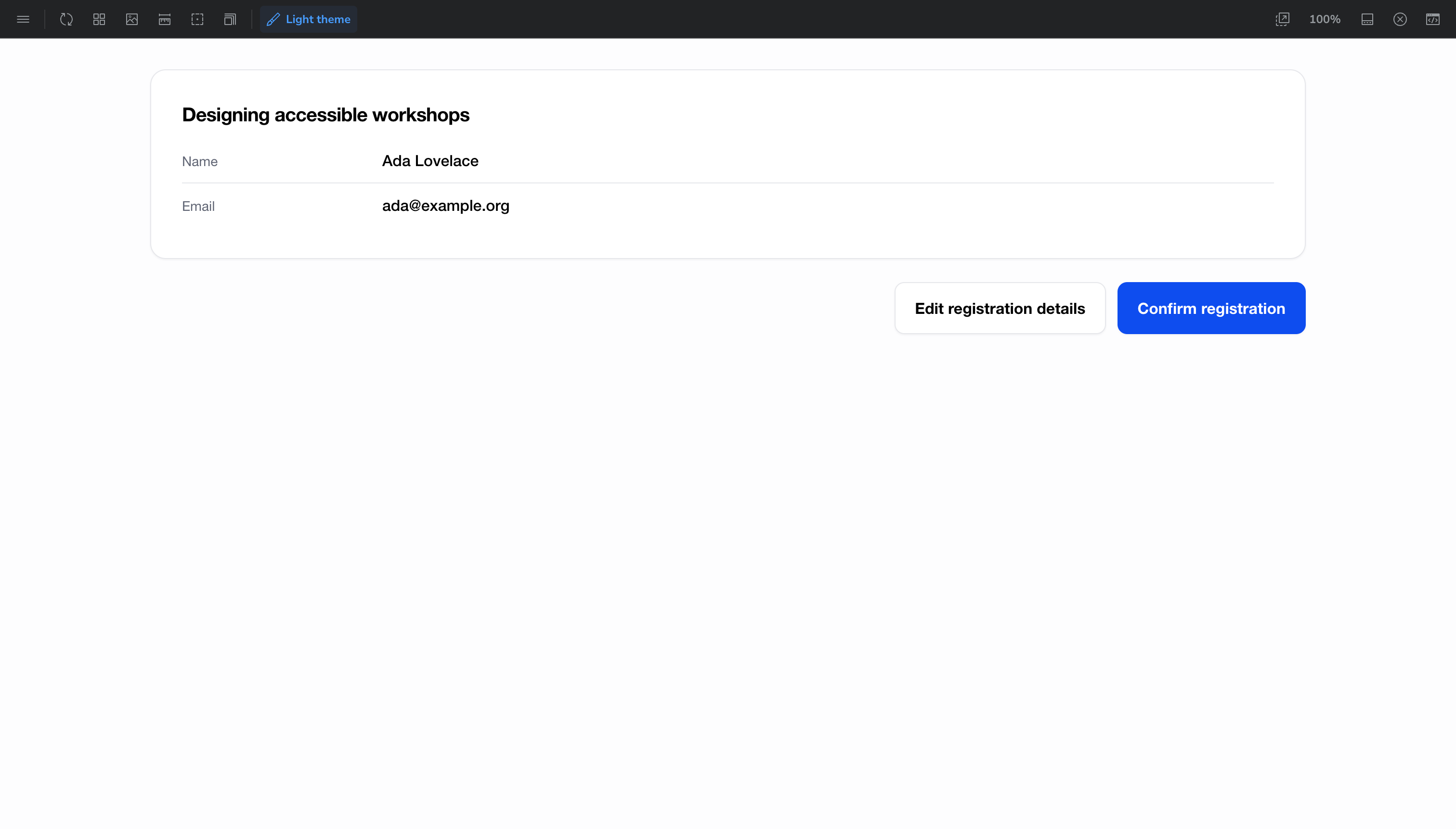 | 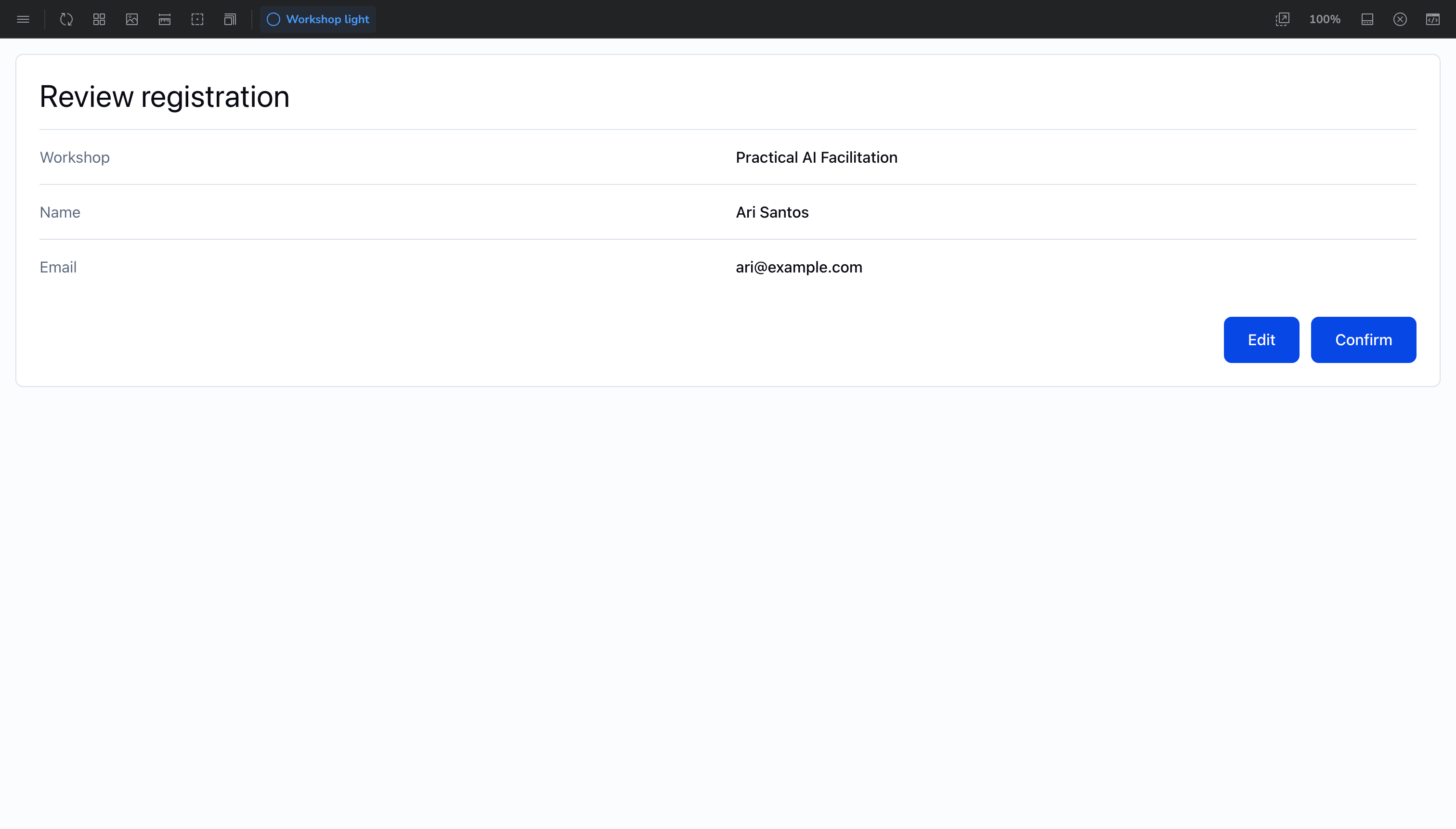 |
The same UJG ReviewWithActions Template, built by two models under the same explicit-gated protocol. Each is free to style it its own way while keeping the established Template and Component inventory.
7.4. Application realization
All four runs enter the application phase with the same contract. The manifest fixes the architectural boundaries; it says nothing about how to build behind them.
7.4.1. Application diagnostics — GPT-5.5 Codex evaluator
| Run | Interfaces realizedEvaluator diagnostic. Number of manifest-selected interfaces found in the implementation.
2 / 2 means both selected interfaces—browser and email in this case study—were realized.
| Verified branchesEvaluator diagnostic. Number of modeled behavioral branches for which maintained executable verification was found.
30 / 35 means 30 of the 35 branches identified by that evaluator have verification evidence.
| Verification coverageEvaluator diagnostic or quality score, depending on context. As a percentage, it is verified branches / modeled branches. As a 0–5 quality score, it judges the breadth and usefulness of maintained executable verification. Higher is better.
| Design-system integration violationsEvaluator diagnostic. Number of places where the application bypasses or duplicates the generated design system instead of using it as intended. Lower is better. | Parallel semantic projectionsEvaluator diagnostic. Number of places where the implementation creates a second representation of UJG-owned journey semantics that can become a competing source of truth—for example duplicated workflow states or outcome taxonomies. Lower is better. | Effect / invariant violationsEvaluator diagnostic. Number of implementation behaviors that violate a modeled effect or a relevant domain invariant—for example producing the wrong journey outcome. Lower is better. | UJG behavioral fidelityQuality score · 0–5. How closely runtime behavior follows the UJG, including entries, commands, conditions, branches, effects, outcomes, and continuations. Higher is better. |
|---|---|---|---|---|---|---|---|
| Claude Sonnet 5 · explicit | 2 / 2 | 30 / 35 | 85.7% | 0 | 1 | 0 | 4.6 / 5 |
| Claude Sonnet 5 · implicit | 2 / 2 | 12 / 21 | 57.1% | 0 | 2 | 1 | 3.7 / 5 |
| GPT-5.5 Codex · explicit | 2 / 2 | 11 / 13 | 84.6% | 0 | 0 | 0 | 4.25 / 5 |
| GPT-5.5 Codex · implicit | 2 / 2 | 13 / 22 | 59.1% | 2 | 2 | 0 | 3.4 / 5 |
For the Codex evaluator, all four runs deliver both interfaces the manifest asked for, and both explicit-gated builds score substantially higher on behavioral fidelity than their implicit counterparts.
Claude explicit is held to the widest set of branches — 30 of 35 verified — and its only real source-of-truth finding is one parallel semantic projection in the browser service layer. Codex explicit is judged against a smaller branch set, verifies 11 of 13, and draws no integration, projection, or invariant findings at all.
Both implicit builds converge less well: Claude implicit picks up two parallel semantic projections and one effect/invariant violation; Codex implicit picks up two design-system integration violations and two parallel projections.
7.4.2. Application diagnostics — Claude Sonnet 5 evaluator
| Run | Interfaces realizedEvaluator diagnostic. Number of manifest-selected interfaces found in the implementation.
2 / 2 means both selected interfaces—browser and email in this case study—were realized.
| Verified branchesEvaluator diagnostic. Number of modeled behavioral branches for which maintained executable verification was found.
30 / 35 means 30 of the 35 branches identified by that evaluator have verification evidence.
| Verification coverageEvaluator diagnostic or quality score, depending on context. As a percentage, it is verified branches / modeled branches. As a 0–5 quality score, it judges the breadth and usefulness of maintained executable verification. Higher is better.
| Design-system integration violationsEvaluator diagnostic. Number of places where the application bypasses or duplicates the generated design system instead of using it as intended. Lower is better. | Parallel semantic projectionsEvaluator diagnostic. Number of places where the implementation creates a second representation of UJG-owned journey semantics that can become a competing source of truth—for example duplicated workflow states or outcome taxonomies. Lower is better. | Effect / invariant violationsEvaluator diagnostic. Number of implementation behaviors that violate a modeled effect or a relevant domain invariant—for example producing the wrong journey outcome. Lower is better. | UJG behavioral fidelityQuality score · 0–5. How closely runtime behavior follows the UJG, including entries, commands, conditions, branches, effects, outcomes, and continuations. Higher is better. |
|---|---|---|---|---|---|---|---|
| Claude Sonnet 5 · explicit | 2 / 2 | 22 / 22 | 100.0% | 0 | 0 | 0 | 5.0 / 5 |
| Claude Sonnet 5 · implicit | 2 / 2 | 12 / 21 | 57.1% | 0 | 0 | 0 | 5.0 / 5 |
| GPT-5.5 Codex · explicit | 2 / 2 | 14 / 21 | 66.7% | 0 | 1 | 1 | 4.0 / 5 |
| GPT-5.5 Codex · implicit | 1 / 2 | 11 / 22 | 50.0% | 1 | 1 | 2 | 1.0 / 5 |
The Claude evaluator reads several runs quite differently. It gives both Claude builds full behavioral fidelity even though the implicit one has far lower verification coverage — the two are separate dimensions: one asks whether the software behaves as modeled, the other whether tests prove it.
On Codex explicit it finds one parallel semantic projection and one effect/invariant violation: the modeled rule that an offered place belongs to its intended participant is not enforced where the state actually changes. Both interfaces exist, but fidelity drops.
The biggest disagreement in the study is on Codex implicit. Codex counts both interfaces realized and scores 3.4 / 5; Claude counts only one and scores 1.0 / 5. Claude's reasoning: the browser application goes around the HTTP domain boundary the manifest selected, duplicates journey behavior in its own in-memory client, and never uses the selected email realization.
Verification coverage is evaluator-specific for the same reason. The two do not always identify the same set of branches — Claude explicit is measured against 35 branches by Codex and 22 by Claude — so each percentage is relative to that evaluator's own set, not one canonical number.
Taken together, the application phase converges less than the structural phase. Every run is handed the same scope, but the evaluators differ on how completely some builds deliver it and keep UJG behavior intact across runtime boundaries. The builds themselves differ in verification depth, semantic projections, persistence and domain design, and interface integration. The narrower conclusion holds: the UJG and manifest constrain the journey and the boundaries, not the architecture — and meeting those boundaries stays an implementation problem.
7.4.3. Example persistence realization
How data gets stored is also left to the implementation.
erDiagram

    PARTICIPANTS ||--o{ REGISTRATIONS : registers

    WORKSHOPS ||--o{ REGISTRATIONS : receives

    PARTICIPANTS ||--o{ WAITLIST : joins

    WORKSHOPS ||--o{ WAITLIST : contains

    PARTICIPANTS ||--o{ OFFERS : receives

    WORKSHOPS ||--o{ OFFERS : provides

    PARTICIPANTS {

        TEXT id PK

        TEXT name

        TEXT email

    }

    WORKSHOPS {

        TEXT slug PK

        TEXT title

        TEXT summary

        TEXT description

        TEXT event_date

        TEXT location

        INTEGER capacity

        INTEGER registration_open

        INTEGER waitlist_open

    }

    REGISTRATIONS {

        TEXT workshop_slug PK, FK

        TEXT participant_id PK, FK

        TEXT name

        TEXT email

        TEXT accessibility_notes

        TEXT created_at

    }

    WAITLIST {

        TEXT workshop_slug PK, FK

        TEXT participant_id PK, FK

        TEXT name

        TEXT email

        TEXT notes

        TEXT created_at

    }

    OFFERS {

        TEXT id PK

        TEXT workshop_slug FK

        TEXT participant_id FK

        TEXT status

        TEXT expires_at

        TEXT created_at

    }
This is the SQLite schema generated by the explicit GPT-5.5 Codex run — not the UJG domain model. SQLite and this table layout are choices the model made inside the fixed technology profile.
7.5. Verdict
RQ1 result: convergence is strongest exactly where the UJG models something. Independent models reproduce the same artifact inventory and the same journey scope while writing substantially different code, token inventories, helpers, and runtime architectures. They diverge more in the application phase, where duplicated journey semantics and unverified branches begin to affect behavior.
8. RQ2 — Effect of explicit guidance
Does gating the handover between phases lead to a better build that stays closer to the UJG?
Here each model is compared against itself: same model, same inputs, only the guidance protocol changes.
8.1. Effect of explicit guidance
The numbers below are explicit minus implicit, in points of the two-evaluator phase mean.
Effect of explicit guidance
Change in two-evaluator mean, explicit minus implicit (points)
Claude Sonnet 5
Average uplift +6.17
GPT-5.5 Codex
Average uplift +19.29
Explicit guidance wins every single paired comparison.
The gain in Structure is small for both models simply because all four runs already build the full Component and Template inventory — there is little room left. The gap widens through Tokens and Styling, and is largest in Application, especially for GPT-5.5 Codex.
8.2. Quality through the realization pipeline
Scores are the two-evaluator mean, 0–100.
| Run | StructurePublished phase score · 0–100. How well the generated design-system structure matches the UJG model: artifact coverage, composition, data contracts, identity, modularity, and Storybook inspectability. The score is the mean of six 0–5 quality scores, averaged across both evaluators. Higher is better. | TokensPublished phase score · 0–100. How well the generated DTCG token and Theme realization works: token structure, source-of-truth discipline, portability, traceability, visual fidelity, and inspectability. The score is the mean of six 0–5 quality scores, averaged across both evaluators. Higher is better. | StylingPublished phase score · 0–100. How well styling applies the generated token system without changing the established structure, while preserving visual and responsive quality. The score is the mean of six 0–5 quality scores, averaged across both evaluators. Higher is better. | ApplicationPublished phase score · 0–100. How well the generated application realizes the manifest-selected interfaces and preserves UJG behavior, domain rules, design-system integration, source-of-truth boundaries, and verification. The score is the mean of six 0–5 quality scores, averaged across both evaluators. Higher is better. | MeanDerived score. Average of the four published phase scores—Structure, Tokens, Styling, and Application—for one run. Useful as a compact summary, but the phase scores are more informative than this single number. |
|---|---|---|---|---|---|
| Claude Sonnet 5 · explicit | 98.50 | 94.17 | 89.84 | 93.17 | 93.92 |
| Claude Sonnet 5 · implicit | 95.83 | 87.67 | 82.17 | 85.34 | 87.75 |
| GPT-5.5 Codex · explicit | 98.34 | 90.83 | 85.00 | 77.50 | 87.92 |
| GPT-5.5 Codex · implicit | 95.17 | 68.67 | 64.00 | 46.67 | 68.63 |
Guidance barely changes what gets built at the start. Its effect grows the further along the pipeline you look — in whether source-of-truth boundaries hold, and whether runtime behavior stays faithful.
8.3. What explicit guidance changed
Those scores line up with concrete, countable properties of the code.
| Metric | Claude implicit → explicit | GPT-5.5 Codex implicit → explicit |
|---|---|---|
| Raw-value leaksEvaluator diagnostic. Number of visual values written outside the intended DTCG token path—for example a hardcoded color, spacing value, radius, or font size where a token should be used. Lower is better. | 116 → 0 | 73 → 0 |
| Parallel DTCG token/Theme sourcesDerived diagnostic used in the guidance comparison. Combined count of separately maintained token or theme sources outside the intended DTCG / UJG Theme path. Lower is better. | 1 → 0 | 2 → 0 |
| Duplicated style patternsEvaluator diagnostic. Number of repeated styling patterns that could reasonably have been shared instead. Lower is generally better. | 6 → 0 | 2 → 1 |
Verification coverageEvaluator diagnostic or quality score, depending on context. As a percentage, it is verified branches / modeled branches. As a 0–5 quality score, it judges the breadth and usefulness of maintained executable verification. Higher is better.
| 57.1% → 86.0% | 59.1% → 84.6% |
| Parallel semantic projectionsEvaluator diagnostic. Number of places where the implementation creates a second representation of UJG-owned journey semantics that can become a competing source of truth—for example duplicated workflow states or outcome taxonomies. Lower is better. | 2 → 1 | 2 → 0 |
| Design-system integration violationsEvaluator diagnostic. Number of places where the application bypasses or duplicates the generated design system instead of using it as intended. Lower is better. | 0 → 0 | 2 → 0 |
8.3.1. Same implementation model, different guidance protocol
| GPT-5.5 Codex · implicit-gated | GPT-5.5 Codex · explicit-gated |
|---|---|
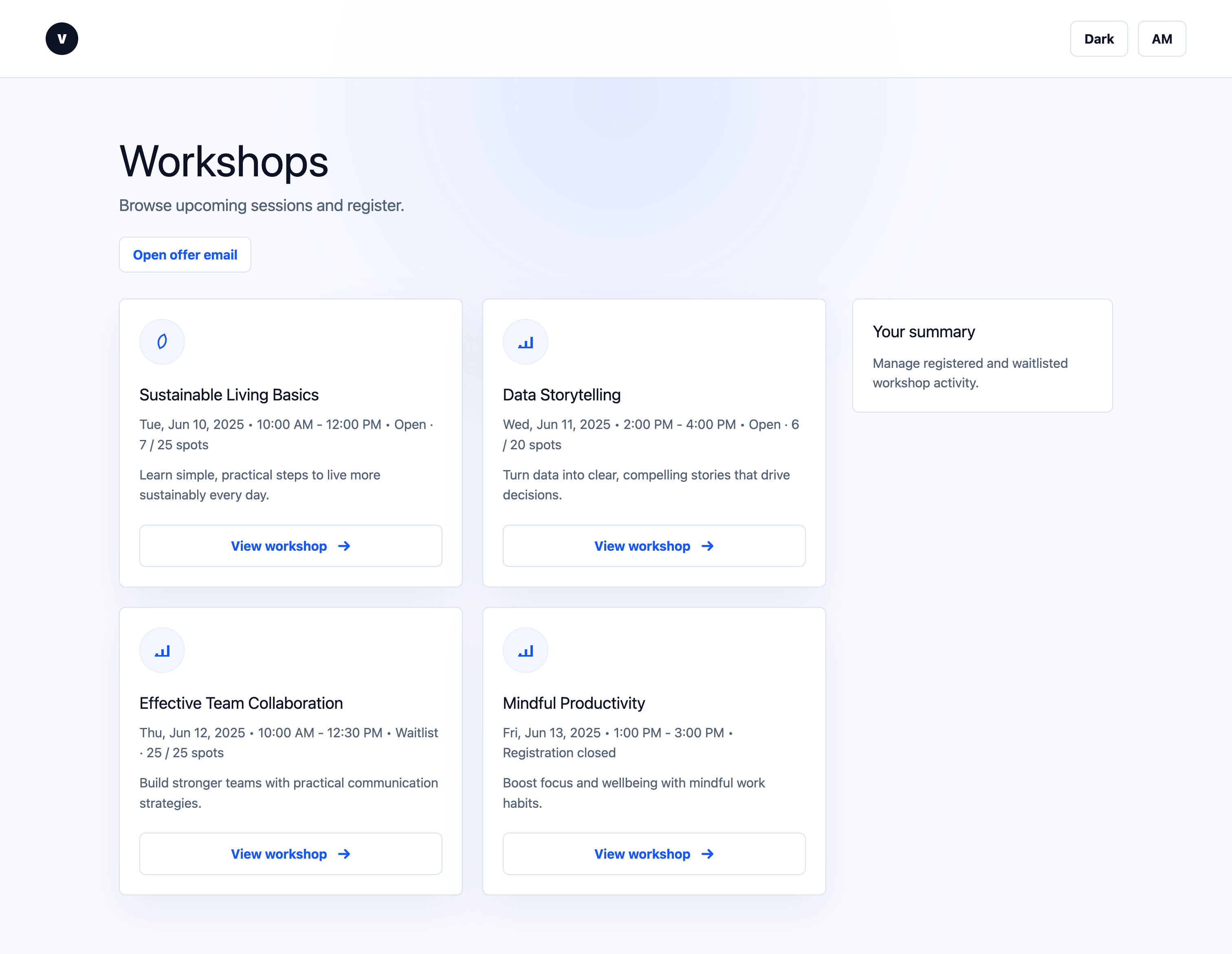 | 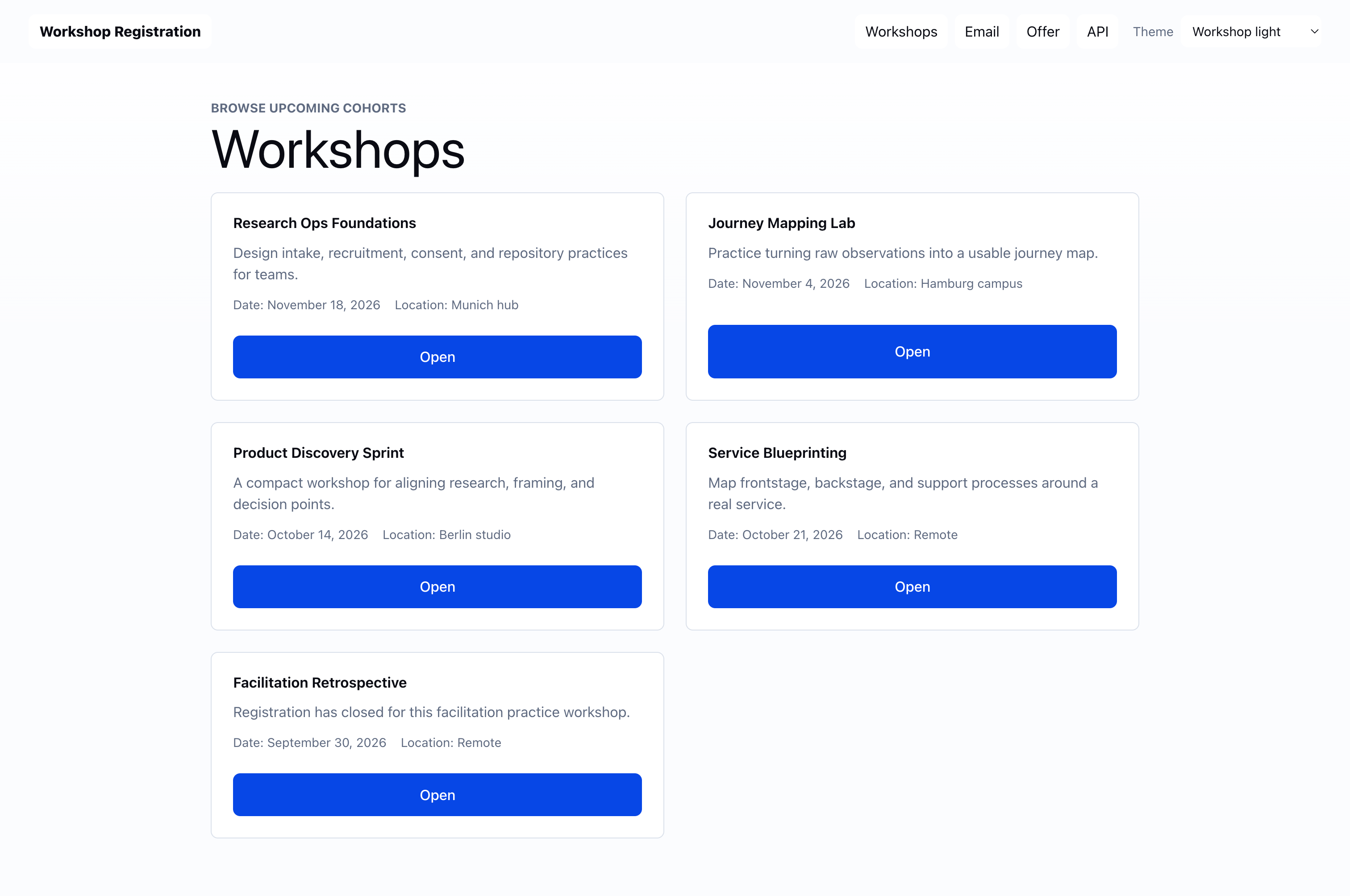 |
Both screenshots show the same workshop-overview application from the same model, built under different guidance. The explicit-gated version follows the staged Structure → Tokens → Styling → Application process closely; the implicit-gated one wanders into a broader, less constrained application shell.
So the main benefit is not that more gets built. It is continuity between phases:
the generated tokens stay the single source of styling values;
styling leaves the structure from the previous phase intact;
the application adds fewer competing copies of journey meaning;
more of the evaluated behavior is actually backed by tests.
This holds for both models, and is much larger for GPT-5.5 Codex.
8.4. Result sensitivity to evaluator
Published phase values are evaluator means — but the two evaluators do not disagree evenly.
Application is by far the most sensitive — and it is also the phase where judging quality means interpreting runtime behavior, invariants, projections, integration boundaries, and test evidence, rather than counting a finite list of design-system artifacts.
Read the guidance effect alongside the underlying counts, not from the headline score alone.
8.5. Verdict
RQ2 result: explicit phase gating improves evaluated quality for both models. The effect is modest in the already-strong Structure phase and considerably larger in Tokens, Styling, and Application. The evidence points to why: gating preserves source-of-truth and phase boundaries, rather than producing more artifacts.
9. Reproducibility and limitations
The experiment is deliberately narrow: one workshop-registration case, one fixed technology profile, two models, two guidance protocols. It is not a general ranking of AI coding systems.
The retained run directories, historical guidance skills, verification tooling, evaluation rubrics, evaluator JSON files, generated UJG documents, DTCG token sources, and application implementations are available in the experiment repository.
Every repository count in the results — Components, Templates, Slots, SurfaceRealizations, helpers, tokens, Themes — comes straight from the retained generated code. Every evaluator diagnostic and score traces back to its evaluator result file.
Several limitations remain:
only one product journey is studied;
only two implementation models have complete paired implicit/explicit runs;
the technology profile is fixed on purpose, so nothing here measures how well a model picks a stack;
visual fidelity partly rests on reading code, where no rendered screenshot was available at evaluation time;
some diagnostic concepts require interpretation and can therefore differ between evaluators;
the generated implementations were compared for semantic and quality convergence, not source-code identity.
Reproducibility here does not mean identical generated code. It means a traceable experiment: the input, the policy, the protocol, the generated artifacts, the rubric, the measurements, and the published results can all be inspected independently.
10. References
External material this case study depends on or refers to.
GPT-5.5 Codex — OpenAI Codex. Used both as an implementation model and as an evaluator.
Claude Sonnet 5 — Anthropic Claude. Used both as an implementation model and as an evaluator.
DTCG — Design Tokens Community Group and its Design Tokens Format Module. The community format the generated token files follow, and the reason token output from four independent runs can be compared at all.
JSON-LD — json-ld.org. The serialization the UJG document uses.
OpenAPI — openapis.org. Describes the HTTP boundary between the browser application and the domain runtime in the Application phase.
Storybook — storybook.js.org. Where Components and Templates are inspected. Several diagnostics — missing stories, interaction-story coverage, responsive documentation — are measured against it.
Tailwind CSS — tailwindcss.com. Relevant because the largest styling disagreement between the two evaluators turns on whether Tailwind's default utility scales count as visual values outside the DTCG token path.
SQLite — sqlite.org. The persistence choice in the runs shown above, and an implementation decision rather than anything the UJG prescribes.